Lumichats 是一款浏览器和桌面端的 AI 编程助手,让不熟悉终端的用户也能通过自然语言运行命令、生成文档,按实际运行量付费。
热门评论
PH 用户
Hi Product Hunt 👋
About 70,000 people use LumiChats in a browser. For a year, the same request kept coming back in different words: can it open the files on my computer? It couldn't. No web app can. That's the ceiling — a chat box can describe the work perfectly and touch none of it.
The tools that do get past that ceiling run in a terminal. Claude Code and the agents like it are genuinely extraordinary; I use one every day and this is not a swipe at them. But almost nobody I know outside engineering can. Not because they aren't capable — because it's a black window that expects you to already know the words.
So the people who'd benefit most from an agent that can actually do things — the researcher with 200 PDFs, the analyst rebuilding the same spreadsheet every Monday, the student writing a thesis at 2am — are exactly the people it keeps out. That's who this is for, and it's why it had to be software you install rather than another tab.
LumiChats is that power with a window on it. You ask in plain English; it writes the commands, runs them on your machine, works on your real files in your real folders, and hands you the finished .docx or .pptx or chart. You never type a command. You just watch it work — and stop it whenever you want. An afternoon of that costs under a dollar.
And there's no subscription. You pay for the work you actually run, not for the calendar. Nothing is running when you're not using it, so there's nothing to cancel and nothing accruing during the month you're busy with something else. I've paid enough monthly bills for tools I opened twice to not want to send you one.
It isn't a walled garden either: point it at any MCP server — your database, your issue tracker, your company's internal search — and it uses that too.
And it's going open source. Something that runs commands on your computer should be something you can read. That's planned rather than done — I'd rather say so here than let the roadmap card imply otherwise.
Two things I care about more than the feature list:
It tells you what it actually read. Every source is logged with the query that found it and whether the page was opened or only appeared in a result list. A report citing twenty-six sources it never opened looks identical to one citing twenty-six it did — until you can see the difference.
It asks before it touches anything. Ask before changes, auto-apply, or read-only. Read-only genuinely means read-only.
One thing to be upfront about: the installer isn't code-signed yet, so Windows SmartScreen will warn you on first run — More info, then Run anyway. A certificate is coming. Every release publishes a SHA-256 hash you can check the download against in the meantime, and I'd rather say that here than have you find it out.
Windows today. macOS and Linux build, but aren't released.
I'm here all day — ask me anything, and please tell me what breaks.
PH 用户
Pay for what you run sounds obviously fairer than a subscription, and it has one nasty failure mode: people start rationing. The moment someone can feel the meter, they stop asking the second and third question, and those are usually the ones that get them the answer. Watch actions per session in week two against week one. If that drops, the pricing is teaching people to use it less, and "under a dollar for an afternoon" won't save you.
PH 用户
"A black window that expects you to already know the words" is exactly why terminal tools stay niche no matter how good they are.
PH 用户
Interesting angle — the terminal is doing more work than people realize, and it's not the typing.
When Claude Code generates something that doesn't compile, the terminal is where the loop closes: the agent sees the error, reads it, and retries. Take the terminal away and someone still has to close that loop. Does Lumichats surface the failure to the user, or does it self-correct silently before they ever see it?
I ask because in my experience that's where the whole "no-terminal" promise usually breaks: the moment a non-technical user is shown a stack trace, you've lost them — but if you hide it and retry blindly, you burn tokens and they wait without knowing why. Curious how you handled it.
PH 用户
Local AI advice usually assumes you have a decent card sitting around, which rules out exactly the students who need it most. Congrats on shipping!
PH 用户
The permission and rollback answers above are thorough. One thing I didn't see: before a task actually runs, does the user get any kind of cost estimate, even a rough one, or do they find out what it cost only after it's done? Pay-per-use only feels safe to explore if you can tell roughly what a big task will cost before committing to it, otherwise the first surprising bill teaches the same rationing lesson Asad described, just from the other direction.
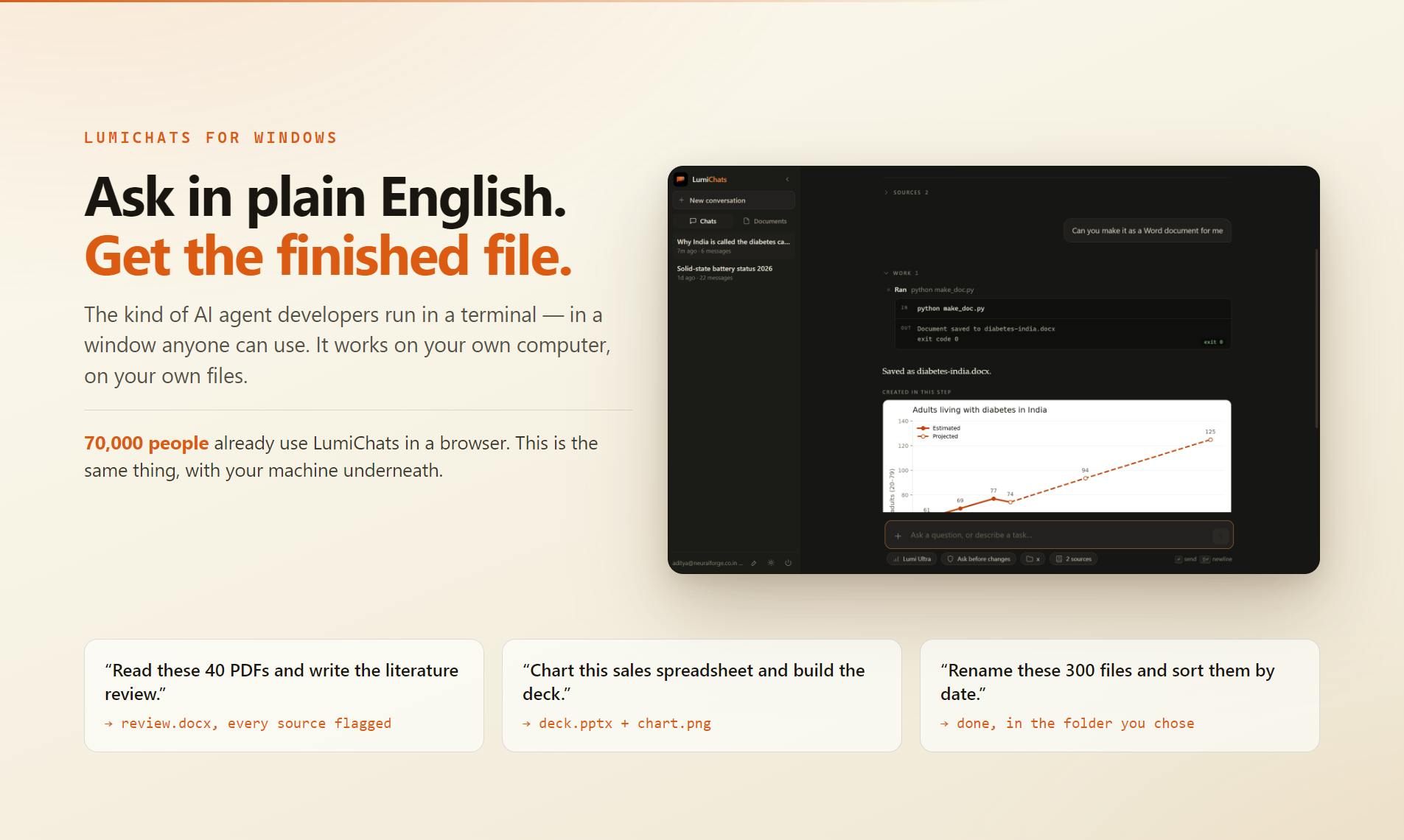
About 70,000 people use LumiChats in a browser. For a year, the same request kept coming back in different words: can it open the files on my computer? It couldn't. No web app can. That's the ceiling — a chat box can describe the work perfectly and touch none of it.
The tools that do get past that ceiling run in a terminal. Claude Code and the agents like it are genuinely extraordinary; I use one every day and this is not a swipe at them. But almost nobody I know outside engineering can. Not because they aren't capable — because it's a black window that expects you to already know the words.
So the people who'd benefit most from an agent that can actually do things — the researcher with 200 PDFs, the analyst rebuilding the same spreadsheet every Monday, the student writing a thesis at 2am — are exactly the people it keeps out. That's who this is for, and it's why it had to be software you install rather than another tab.
LumiChats is that power with a window on it. You ask in plain English; it writes the commands, runs them on your machine, works on your real files in your real folders, and hands you the finished .docx or .pptx or chart. You never type a command. You just watch it work — and stop it whenever you want. An afternoon of that costs under a dollar.
And there's no subscription. You pay for the work you actually run, not for the calendar. Nothing is running when you're not using it, so there's nothing to cancel and nothing accruing during the month you're busy with something else. I've paid enough monthly bills for tools I opened twice to not want to send you one.
It isn't a walled garden either: point it at any MCP server — your database, your issue tracker, your company's internal search — and it uses that too.
And it's going open source. Something that runs commands on your computer should be something you can read. That's planned rather than done — I'd rather say so here than let the roadmap card imply otherwise.
Two things I care about more than the feature list:
It tells you what it actually read. Every source is logged with the query that found it and whether the page was opened or only appeared in a result list. A report citing twenty-six sources it never opened looks identical to one citing twenty-six it did — until you can see the difference.
It asks before it touches anything. Ask before changes, auto-apply, or read-only. Read-only genuinely means read-only.
One thing to be upfront about: the installer isn't code-signed yet, so Windows SmartScreen will warn you on first run — More info, then Run anyway. A certificate is coming. Every release publishes a SHA-256 hash you can check the download against in the meantime, and I'd rather say that here than have you find it out.
Windows today. macOS and Linux build, but aren't released.
I'm here all day — ask me anything, and please tell me what breaks.
When Claude Code generates something that doesn't compile, the terminal is where the loop closes: the agent sees the error, reads it, and retries. Take the terminal away and someone still has to close that loop. Does Lumichats surface the failure to the user, or does it self-correct silently before they ever see it?
I ask because in my experience that's where the whole "no-terminal" promise usually breaks: the moment a non-technical user is shown a stack trace, you've lost them — but if you hide it and retry blindly, you burn tokens and they wait without knowing why. Curious how you handled it.