Most Jev demos ask the model for one decision: moderate this comment, route this email, score this ticket. I wanted to see what ten thousand decisions about the same text look like, so I built a town and put Jev in every house.
You write a post, a listing, a product or a headline. The 600 residents it should matter to read it first, and it travels further only while more of them are glad than annoyed. A weak text dies in the first wave for half a cent. A good one reaches all 10,000 in 14 seconds for about ten cents.
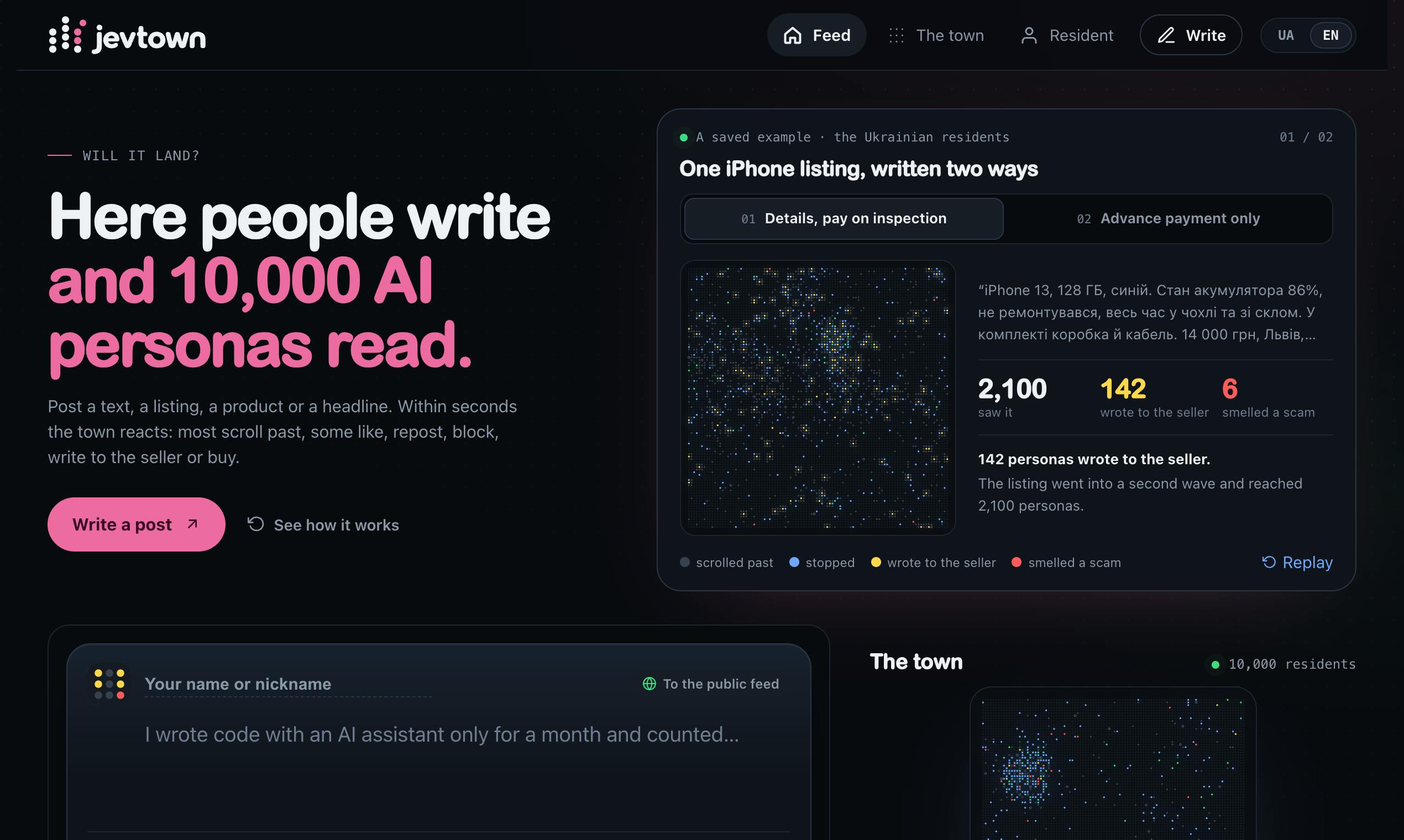
The test that convinced me: I wrote one iPhone listing two ways. The version that lets the buyer pay on inspection reached 2,100 residents and 142 wrote to the seller. The advance-payment-only rewrite reached 600 and stopped, with 204 of them suspecting a scam.
Three things I measured before building any of it, in case they help someone else building on Jev:
1. 200 personas in one request answer the same as one asked alone, so batching costs nothing in accuracy. 2. Reversing the order of the options shifts answers by 0.062, two and a half times the noise between two identical calls. So the order is fixed and never shuffled. 3. Asking "what is the highest price this buyer would pay" turns 90% of people into buyers. Writing the base rate into the question gives 48%, which matches what they actually do elsewhere in the same run. The calibration is real, but it calibrates the question you wrote.
No sign-in, no accounts. Ukrainian and English, and the language of your text picks the town.
Try it: https://jevtown.ivanhabor.com
The 30-second film of the two listings: https://youtu.be/Ktm2qwW7JAo
I would most like to hear about texts where the town got it wrong.
PH 用户
I like it. Beautiful UI and cool Jev usecase. I'm sure many people are using Jev for AI detection but seems like a good use case here too
PH 用户
The idea of testing copy against actual simulated demand before spending on distribution is pretty interesting. The 14 second feedback loop sounds especially useful.
PH 用户
What's new in Jevtown: why the town passed, your own audience, and an MCP server https://youtu.be/cDokxlOpKac?si=x2XQNJ2fWgAksFxn Three things came out of the launch comments, and all three are live.
The town says why. When a check finishes, up to 100 of the people it reached get one more question. Those who scrolled past or got annoyed pick a reason, and those who liked it say what stopped them. For a post, those who stopped also say what they would comment. The page splits the reasons into ones about the text and ones about the audience, so you can tell a weak opening from the wrong readers. Jev also answers a few yes or no questions about the text itself:Is there a concrete number, name or example?Is it clear what the reader should do?For a listing, does the first sentence say what is for sale?Your own audience, in words. Describe whom the text is for, and only the residents who fit read it. "People who work in IT and are into startups" is 238 people, "people over 60" is 1,398. The town has no data on cities or company stages, so words about those do not count. The Audience tab shows how Jev read the description.
An MCP server. Jev writes no text, but an agent can. With the server, Claude or another MCP client writes variants, compares up to five on the first wave and follows the best one through the town. It runs on your own Jev key.
Before shipping, I tested every new question with paid runs and dropped three that did not hold up: how far people read, whether a text reads as written by AI, and whether a post puts its main point first. The numbers are in docs/measurements.md.
Try it: https://jevtown.ivanhabor.com
Code: https://github.com/gaborishka/jevtown
PH 用户
What's new in Jevtown: why the town passed, your own audience, and an MCP server
https://youtu.be/cDokxlOpKac?si=CsCbkuLgkeFmoRMZ
Three things came out of the launch comments, and all three are live.
The town says why. When a check finishes, up to 100 of the people it reached get one more question. Those who scrolled past or got annoyed pick a reason, and those who liked it say what stopped them. For a post, those who stopped also say what they would comment. The page splits the reasons into ones about the text and ones about the audience, so you can tell a weak opening from the wrong readers. Jev also answers a few yes or no questions about the text itself:Is there a concrete number, name or example?Is it clear what the reader should do?For a listing, does the first sentence say what is for sale?Your own audience, in words. Describe whom the text is for, and only the residents who fit read it. "People who work in IT and are into startups" is 238 people, "people over 60" is 1,398. The town has no data on cities or company stages, so words about those do not count. The Audience tab shows how Jev read the description.
An MCP server. Jev writes no text, but an agent can. With the server, Claude or another MCP client writes variants, compares up to five on the first wave and follows the best one through the town. It runs on your own Jev key.
Before shipping, I tested every new question with paid runs and dropped three that did not hold up: how far people read, whether a text reads as written by AI, and whether a post puts its main point first. The numbers are in docs/measurements.md.
Most Jev demos ask the model for one decision: moderate this comment, route this email, score this ticket. I wanted to see what ten thousand decisions about the same text look like, so I built a town and put Jev in every house.
You write a post, a listing, a product or a headline. The 600 residents it should matter to read it first, and it travels further only while more of them are glad than annoyed. A weak text dies in the first wave for half a cent. A good one reaches all 10,000 in 14 seconds for about ten cents.
The test that convinced me: I wrote one iPhone listing two ways. The version that lets the buyer pay on inspection reached 2,100 residents and 142 wrote to the seller. The advance-payment-only rewrite reached 600 and stopped, with 204 of them suspecting a scam.
Three things I measured before building any of it, in case they help someone else building on Jev:
1. 200 personas in one request answer the same as one asked alone, so batching costs nothing in accuracy.
2. Reversing the order of the options shifts answers by 0.062, two and a half times the noise between two identical calls. So the order is fixed and never shuffled.
3. Asking "what is the highest price this buyer would pay" turns 90% of people into buyers. Writing the base rate into the question gives 48%, which matches what they actually do elsewhere in the same run. The calibration is real, but it calibrates the question you wrote.
No sign-in, no accounts. Ukrainian and English, and the language of your text picks the town.
Try it: https://jevtown.ivanhabor.com
The 30-second film of the two listings: https://youtu.be/Ktm2qwW7JAo
I would most like to hear about texts where the town got it wrong.
https://youtu.be/cDokxlOpKac?si=x2XQNJ2fWgAksFxn
Three things came out of the launch comments, and all three are live.
The town says why. When a check finishes, up to 100 of the people it reached get one more question. Those who scrolled past or got annoyed pick a reason, and those who liked it say what stopped them. For a post, those who stopped also say what they would comment. The page splits the reasons into ones about the text and ones about the audience, so you can tell a weak opening from the wrong readers. Jev also answers a few yes or no questions about the text itself:Is there a concrete number, name or example?Is it clear what the reader should do?For a listing, does the first sentence say what is for sale?Your own audience, in words. Describe whom the text is for, and only the residents who fit read it. "People who work in IT and are into startups" is 238 people, "people over 60" is 1,398. The town has no data on cities or company stages, so words about those do not count. The Audience tab shows how Jev read the description.
An MCP server. Jev writes no text, but an agent can. With the server, Claude or another MCP client writes variants, compares up to five on the first wave and follows the best one through the town. It runs on your own Jev key.
Before shipping, I tested every new question with paid runs and dropped three that did not hold up: how far people read, whether a text reads as written by AI, and whether a post puts its main point first. The numbers are in docs/measurements.md.
Try it: https://jevtown.ivanhabor.com
Code: https://github.com/gaborishka/jevtown
https://youtu.be/cDokxlOpKac?si=CsCbkuLgkeFmoRMZ
Three things came out of the launch comments, and all three are live.
The town says why. When a check finishes, up to 100 of the people it reached get one more question. Those who scrolled past or got annoyed pick a reason, and those who liked it say what stopped them. For a post, those who stopped also say what they would comment. The page splits the reasons into ones about the text and ones about the audience, so you can tell a weak opening from the wrong readers. Jev also answers a few yes or no questions about the text itself:Is there a concrete number, name or example?Is it clear what the reader should do?For a listing, does the first sentence say what is for sale?Your own audience, in words. Describe whom the text is for, and only the residents who fit read it. "People who work in IT and are into startups" is 238 people, "people over 60" is 1,398. The town has no data on cities or company stages, so words about those do not count. The Audience tab shows how Jev read the description.
An MCP server. Jev writes no text, but an agent can. With the server, Claude or another MCP client writes variants, compares up to five on the first wave and follows the best one through the town. It runs on your own Jev key.
Before shipping, I tested every new question with paid runs and dropped three that did not hold up: how far people read, whether a text reads as written by AI, and whether a post puts its main point first. The numbers are in docs/measurements.md.
Try it: https://jevtown.ivanhabor.com
Code: https://github.com/gaborishka/jevtown