推荐Hermes /learn流程:先研究再学习。
pro tip for Hermes /learn:
don’t treat it like dumping random memory, but create a space before it learns.
build a private channel and call it Learnables / learning room, whatever you like.
on discord, every topic becomes its own thread.
on Telegram, every topic becomes a forum topic or reply chain...
then drop one messy topic like: how should my agent handle Stripe disputes?
Hermes researches it first:
docs, examples, common mistakes, commands, links, and rough workflow.
then you add your own context for example ,make it founder-friendly , ignore the enterprise stuff ,add your Discord support flow, basically whatever actually fits your setup...
basically, you clean it up before telling it to learn.
only after that, say: learn this
now Hermes learns the reviewed version, not the messy first thought.
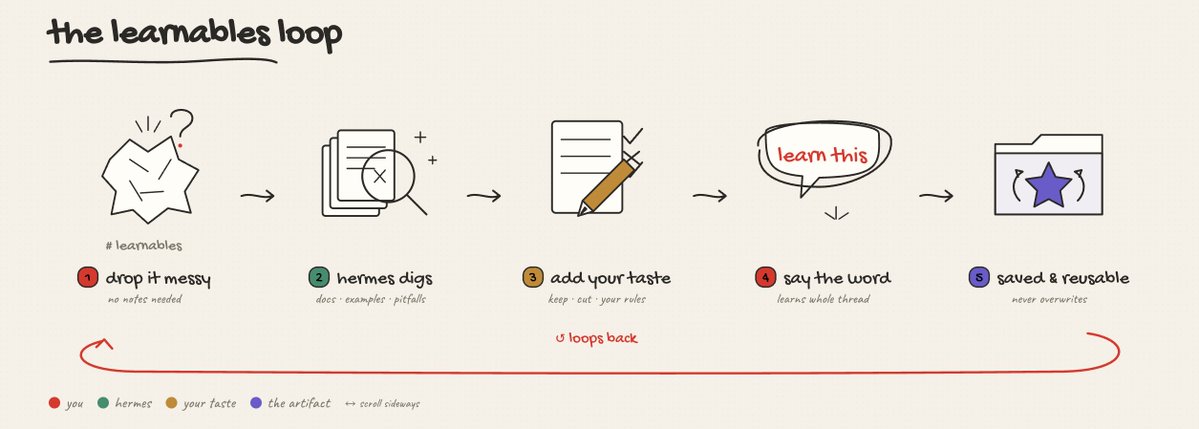
topic → research room → your taste → reusable workflow
that’s the real /learn loop and not just remember this but more like:
>research this
>organize it
>let me correct it
>then learn the cleaned version
that little research space before learning is where the skill gets good.. i put prompt of how to build this below..
/////////////
====== PROMPT========
Build a Learnables workflow for Hermes that works on either Discord or Telegram.
Goal:
Make /learn more useful by adding a research/review space before Hermes learns anything.
Core idea:
Users should not have to write perfect notes. They should drop a messy topic, let Hermes research it, add their own taste/context, then approve it with “learn this”.
Platform behavior:
If Discord:
- Create or use a private channel called #learnables.
- Every top-level message in #learnables becomes its own thread.
- Hermes replies inside the thread with a research/context pack.
- User reviews inside the thread.
- When user says “learn this”, Hermes learns from the whole thread.
If Telegram:
- If forum topics are enabled, create or use a Learnables forum group.
- Every new topic becomes its own forum topic.
- Hermes replies inside that topic with a research/context pack.
- User reviews inside the topic.
- When user says “learn this”, Hermes learns from the whole topic.
- If forum topics are not enabled, use reply chains:
- first message starts the learnable
- Hermes replies with a unique Learnable ID
- all replies to that message belong to that learnable
- “learn this” learns from that reply chain.
Research/context pack:
When a new topic is created, Hermes should not create a skill yet.
It should first gather:
- official docs and primary sources
- examples
- common mistakes
- useful commands
- links
- rough workflow
- what to ignore
- open questions for the user
Review step:
The user can add:
- their preferred tone
- constraints
- examples
- bad examples
- project-specific context
- what to keep
- what to remove
Learning step:
Only after the user explicitly says:
- learn this
- save this
- turn this into a workflow
- make this reusable
Then Hermes turns the reviewed thread/topic/reply chain into a reusable learned workflow.
Final output after learning:
- short title
- what Hermes learned
- when to reuse it
- example trigger phrases
- source links used
- any user-specific preferences captured
Important rules:
- One topic per thread/topic/reply chain.
- Do not learn from the first messy message.
- Research first, learn later.
- Prefer official/primary sources.
- Keep it practical, not academic.
- Never overwrite existing learned workflows without asking.
- Confirm before saving if the context is unclear.
Example:
User posts:
how should my agent handle Stripe disputes?
Hermes creates a research room and gathers:
- Stripe dispute docs
- evidence submission examples
- common SaaS mistakes
- recommended support flow
- questions for the user
User replies:
make it founder-friendly
ignore enterprise stuff
add our Discord support flow
User says:
learn this
Hermes saves the cleaned workflow, not the messy first thought.
===== END OF PROMPT======
don’t treat it like dumping random memory, but create a space before it learns.
build a private channel and call it Learnables / learning room, whatever you like.
on discord, every topic becomes its own thread.
on Telegram, every topic becomes a forum topic or reply chain...
then drop one messy topic like: how should my agent handle Stripe disputes?
Hermes researches it first:
docs, examples, common mistakes, commands, links, and rough workflow.
then you add your own context for example ,make it founder-friendly , ignore the enterprise stuff ,add your Discord support flow, basically whatever actually fits your setup...
basically, you clean it up before telling it to learn.
only after that, say: learn this
now Hermes learns the reviewed version, not the messy first thought.
topic → research room → your taste → reusable workflow
that’s the real /learn loop and not just remember this but more like:
>research this
>organize it
>let me correct it
>then learn the cleaned version
that little research space before learning is where the skill gets good.. i put prompt of how to build this below..
/////////////
====== PROMPT========
Build a Learnables workflow for Hermes that works on either Discord or Telegram.
Goal:
Make /learn more useful by adding a research/review space before Hermes learns anything.
Core idea:
Users should not have to write perfect notes. They should drop a messy topic, let Hermes research it, add their own taste/context, then approve it with “learn this”.
Platform behavior:
If Discord:
- Create or use a private channel called #learnables.
- Every top-level message in #learnables becomes its own thread.
- Hermes replies inside the thread with a research/context pack.
- User reviews inside the thread.
- When user says “learn this”, Hermes learns from the whole thread.
If Telegram:
- If forum topics are enabled, create or use a Learnables forum group.
- Every new topic becomes its own forum topic.
- Hermes replies inside that topic with a research/context pack.
- User reviews inside the topic.
- When user says “learn this”, Hermes learns from the whole topic.
- If forum topics are not enabled, use reply chains:
- first message starts the learnable
- Hermes replies with a unique Learnable ID
- all replies to that message belong to that learnable
- “learn this” learns from that reply chain.
Research/context pack:
When a new topic is created, Hermes should not create a skill yet.
It should first gather:
- official docs and primary sources
- examples
- common mistakes
- useful commands
- links
- rough workflow
- what to ignore
- open questions for the user
Review step:
The user can add:
- their preferred tone
- constraints
- examples
- bad examples
- project-specific context
- what to keep
- what to remove
Learning step:
Only after the user explicitly says:
- learn this
- save this
- turn this into a workflow
- make this reusable
Then Hermes turns the reviewed thread/topic/reply chain into a reusable learned workflow.
Final output after learning:
- short title
- what Hermes learned
- when to reuse it
- example trigger phrases
- source links used
- any user-specific preferences captured
Important rules:
- One topic per thread/topic/reply chain.
- Do not learn from the first messy message.
- Research first, learn later.
- Prefer official/primary sources.
- Keep it practical, not academic.
- Never overwrite existing learned workflows without asking.
- Confirm before saving if the context is unclear.
Example:
User posts:
how should my agent handle Stripe disputes?
Hermes creates a research room and gathers:
- Stripe dispute docs
- evidence submission examples
- common SaaS mistakes
- recommended support flow
- questions for the user
User replies:
make it founder-friendly
ignore enterprise stuff
add our Discord support flow
User says:
learn this
Hermes saves the cleaned workflow, not the messy first thought.
===== END OF PROMPT======