Jason, the claim-by-claim evidence record is the detail I'd look at first. A reviewer needs something they can check when deciding whether a draft is ready to publish.
PH 用户
100% serverless on Google Cloud: 9 Cloud Run services (4 product, 5 internal ops agents), zero VMs to manage.
Hey Product Hunt, I'm Jason, maker of WriterzRoom.
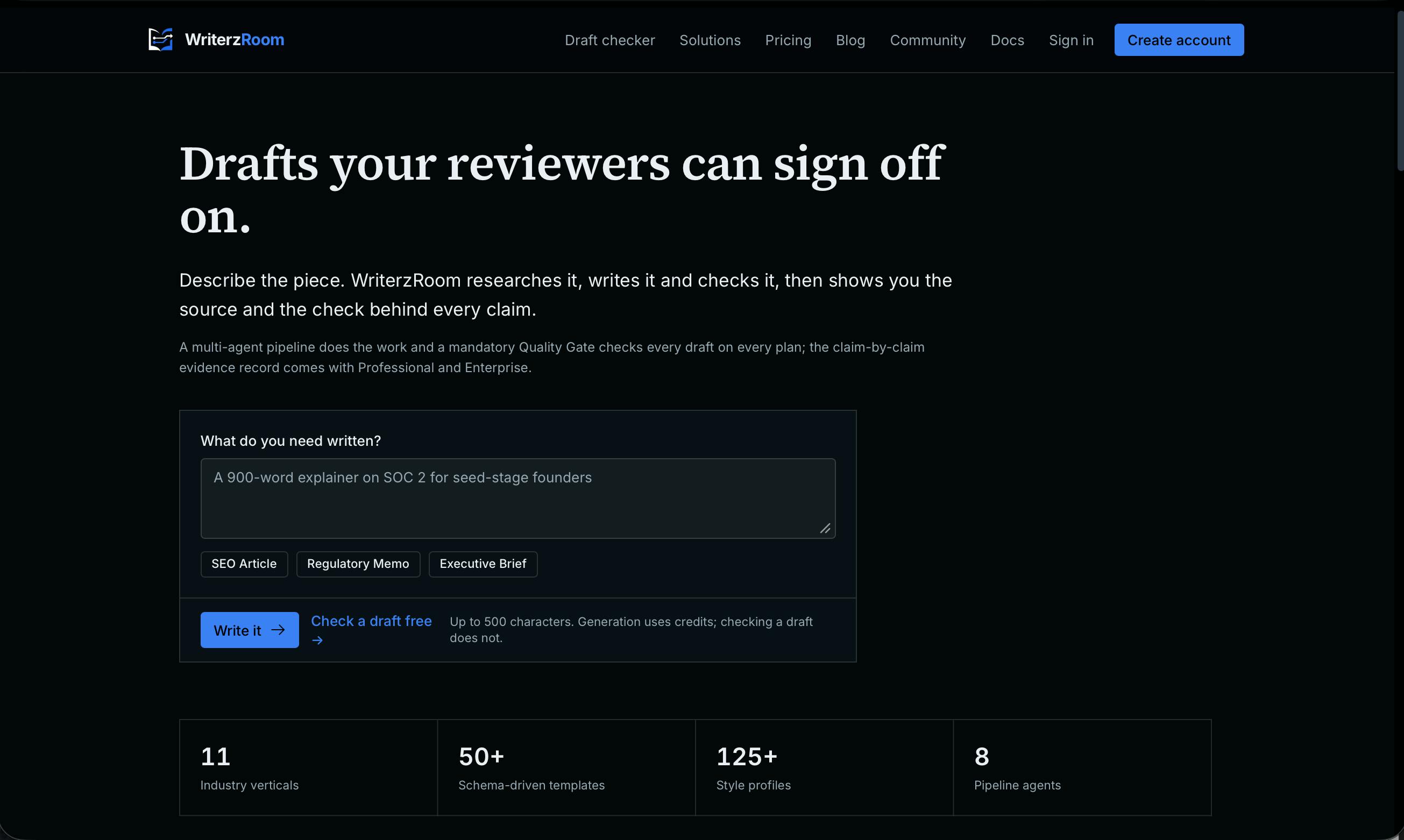
Generic AI writers produce text. Regulated teams need drafts a reviewer can sign off on. WriterzRoom runs each request through an 8-agent LangGraph pipeline, constrained by template schema and vertical controls, and held at a mandatory Quality Gate until it passes. Professional and Enterprise plans add a claim-by-claim evidence record.
Our checks are deterministic rules, and a suite of documents with planted defects runs on every pull request: 23 of 23 seeded defects caught, 0 of 13 clean documents blocked. You can check a draft free, no credits needed.
The video above is an animated walkthrough with illustrative data.
How we use Cloud Run:writerzroom-backend-api: FastAPI + LangGraph orchestration. Scales with generation and publishing load, and Cloud Run's request timeouts handle long-running agent chains.writerzroom-frontend-web: Next.js 15 (1 vCPU / 1 GiB, 1→5 instances, health-checked startup probe), serving writerzroom.com.writerzroom-mcp and writerzroom-corpus-mcp: two MCP servers that expose platform tools and the content corpus to the agents.Internal ops, same stack: five agents (analytics, competitive intel, prospect research, outreach, content pipeline) that I use to run WriterzRoom itself, deployed the same way as the product.Wiring: Cloud Build CI/CD (a regression suite gates every deploy) → Artifact Registry images → Cloud Run. Secret Manager for every credential, a Serverless VPC connector to private Cloud SQL Postgres, per-service IAM service accounts, and Cloud Scheduler for auto-publishing.Why Cloud Run: elastic under load, one deploy path for every service, and no servers to patch.
Happy to dig into any of it: how we run LangGraph chains on Cloud Run, the validation layer, or how the services stay wired together. What would you want to see next?
Hey Product Hunt, I'm Jason, maker of WriterzRoom.
Generic AI writers produce text. Regulated teams need drafts a reviewer can sign off on. WriterzRoom runs each request through an 8-agent LangGraph pipeline, constrained by template schema and vertical controls, and held at a mandatory Quality Gate until it passes. Professional and Enterprise plans add a claim-by-claim evidence record.
Our checks are deterministic rules, and a suite of documents with planted defects runs on every pull request: 23 of 23 seeded defects caught, 0 of 13 clean documents blocked. You can check a draft free, no credits needed.
The video above is an animated walkthrough with illustrative data.
How we use Cloud Run:writerzroom-backend-api: FastAPI + LangGraph orchestration. Scales with generation and publishing load, and Cloud Run's request timeouts handle long-running agent chains.writerzroom-frontend-web: Next.js 15 (1 vCPU / 1 GiB, 1→5 instances, health-checked startup probe), serving writerzroom.com.writerzroom-mcp and writerzroom-corpus-mcp: two MCP servers that expose platform tools and the content corpus to the agents.Internal ops, same stack: five agents (analytics, competitive intel, prospect research, outreach, content pipeline) that I use to run WriterzRoom itself, deployed the same way as the product.Wiring: Cloud Build CI/CD (a regression suite gates every deploy) → Artifact Registry images → Cloud Run. Secret Manager for every credential, a Serverless VPC connector to private Cloud SQL Postgres, per-service IAM service accounts, and Cloud Scheduler for auto-publishing.Why Cloud Run: elastic under load, one deploy path for every service, and no servers to patch.
Happy to dig into any of it: how we run LangGraph chains on Cloud Run, the validation layer, or how the services stay wired together. What would you want to see next?