OpenSwarm 是一个智能体优先的操作系统,让成群 AI 智能体接管整台电脑,自动创建应用、操控浏览器并并行执行任务,适合希望自动化多步骤工作流的开发者与团队。
热门评论
PH 用户
Awesome idea! Is OpenSwarm a stand-alone OS on bare metal or runs on top of macOS/Windows/Linux, and is it possible to use my own models/API keys? Btw, Congratulations on the launch @haylli_weintraub , @eric_f_zeng and team OpenSwarm 🚀
PH 用户
Hey Product Hunt 👋 I’m Eric, co-founder and CTO of OpenSwarm.
Your AI tools can do a lot. But you can still end up connecting everything: moving files between apps, repeating the same context, carrying one model’s answer into another conversation, and tracking what each agent is doing.
You shouldn’t have to be the shared memory between your AI tools.
We’ve spent the last four years at Berkeley researching how agents work together: how they share memory, coordinate tasks, use browsers, and build on each other’s work. OpenSwarm brings that research into a product designed for everyday people, not just developers.
Our belief is simple: making models smarter is only part of the problem. We also need to change the environment they work in.
That’s why we built OpenSwarm: an AI-first operating system designed for you and a swarm of agents to work together. An army of agents, in the same place you work.
It runs on your own computer, across desktop platforms, bringing your models, apps, files and agents into one infinite canvas.
Here’s what that means in practice:
🧠Shared context across models and conversations. The memory, skills and workflows you build in OpenSwarm aren’t tied to one model or one chat. Switch models without rebuilding your saved context. Agents can share findings and build on work that’s already been done.
🔗Your existing tools, connected. Bring together Gmail, Calendar, Drive, Slack, Notion, GitHub and more, alongside your local files and the browser accounts you’re already signed into. Give agents a job that crosses tools, rather than moving the information between them yourself.
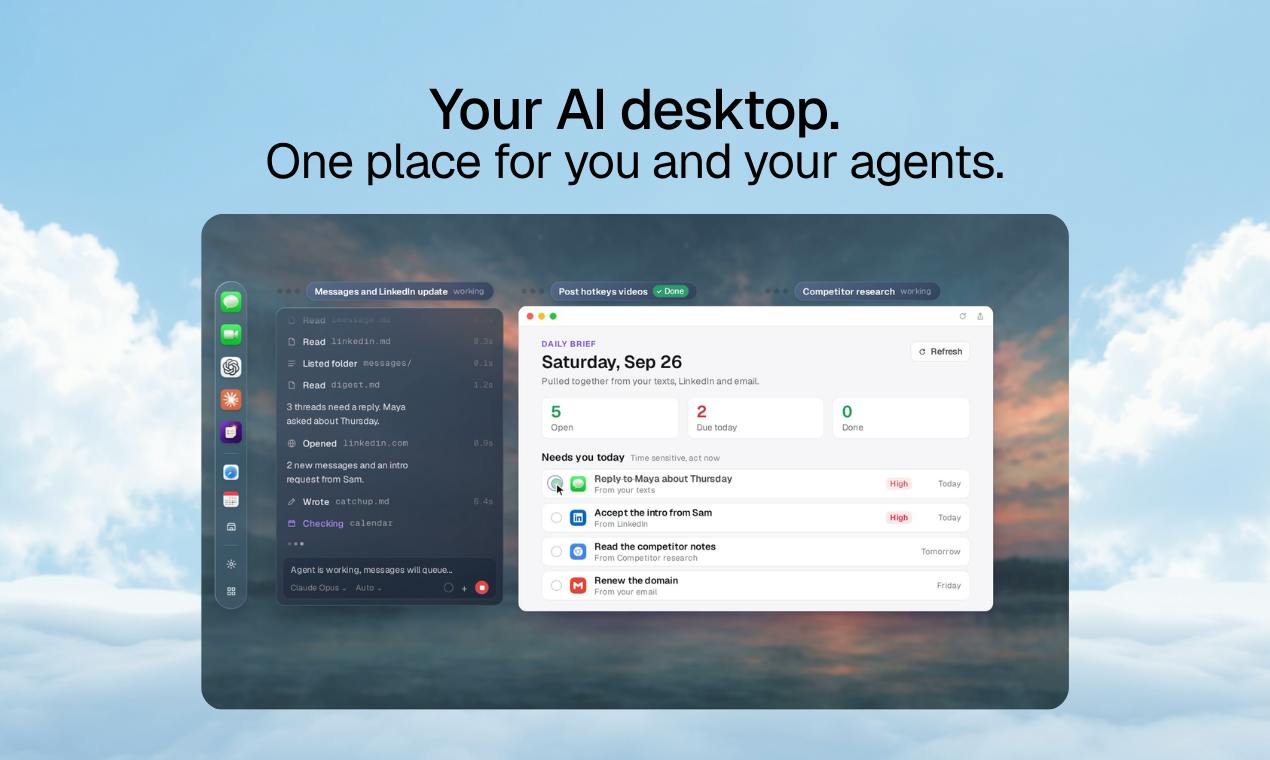
🐝Agents working together, not just more chats to manage. Send a swarm to research different sources, analyze files or build software in parallel. Their browsers, apps and documents appear as live cards on the canvas, where you can inspect, interact with and guide the work. Outward-facing actions, like sending emails or publishing posts, wait for your approval.
For example, ask OpenSwarm to research a set of companies using the web and your project files, turn the findings into a comparison spreadsheet, and build a dashboard to track them. The agents can divide up the research, share what they find and create the outputs in the same workspace.
And when you need a tool that doesn’t exist, describe it. OpenSwarm can build a working app with source code in a folder you own, running alongside the rest of your work.
The shift we’re building for is from doing every task yourself to directing work happening in parallel—without losing the context or control.
OpenSwarm is free, and access is currently waitlist-only. You bring your existing Claude or ChatGPT subscription, or your own model credits; those costs are separate from the free OpenSwarm app.
Join the waitlist on our website to request access. We’d love your feedback as we build this.
What’s the first job you’d give your swarm?
PH 用户
@eric_f_zeng I like the Idea of agents working together instead of having 10 different chats open. What kind of tasks work best with a swarm?
PH 用户
I just generated a page for our campaign and it pulled our brand voice in like two mints. pretty solid execution.
PH 用户
Can access be limited per agent or per application?
Btw, Congratulations on the launch @haylli_weintraub , @eric_f_zeng and team OpenSwarm 🚀
Your AI tools can do a lot. But you can still end up connecting everything: moving files between apps, repeating the same context, carrying one model’s answer into another conversation, and tracking what each agent is doing.
You shouldn’t have to be the shared memory between your AI tools.
We’ve spent the last four years at Berkeley researching how agents work together: how they share memory, coordinate tasks, use browsers, and build on each other’s work. OpenSwarm brings that research into a product designed for everyday people, not just developers.
Our belief is simple: making models smarter is only part of the problem. We also need to change the environment they work in.
That’s why we built OpenSwarm: an AI-first operating system designed for you and a swarm of agents to work together. An army of agents, in the same place you work.
It runs on your own computer, across desktop platforms, bringing your models, apps, files and agents into one infinite canvas.
Here’s what that means in practice:
🧠Shared context across models and conversations. The memory, skills and workflows you build in OpenSwarm aren’t tied to one model or one chat. Switch models without rebuilding your saved context. Agents can share findings and build on work that’s already been done.
🔗Your existing tools, connected. Bring together Gmail, Calendar, Drive, Slack, Notion, GitHub and more, alongside your local files and the browser accounts you’re already signed into. Give agents a job that crosses tools, rather than moving the information between them yourself.
🐝Agents working together, not just more chats to manage. Send a swarm to research different sources, analyze files or build software in parallel. Their browsers, apps and documents appear as live cards on the canvas, where you can inspect, interact with and guide the work. Outward-facing actions, like sending emails or publishing posts, wait for your approval.
For example, ask OpenSwarm to research a set of companies using the web and your project files, turn the findings into a comparison spreadsheet, and build a dashboard to track them. The agents can divide up the research, share what they find and create the outputs in the same workspace.
And when you need a tool that doesn’t exist, describe it. OpenSwarm can build a working app with source code in a folder you own, running alongside the rest of your work.
The shift we’re building for is from doing every task yourself to directing work happening in parallel—without losing the context or control.
OpenSwarm is free, and access is currently waitlist-only. You bring your existing Claude or ChatGPT subscription, or your own model credits; those costs are separate from the free OpenSwarm app.
Join the waitlist on our website to request access. We’d love your feedback as we build this.
What’s the first job you’d give your swarm?