NovaSynth 为语音智能体提供大规模真实来电者模拟测试,生成多口音、噪声与打断场景,并从音频和转写中评分定位故障,供语音 AI 开发团队使用。
热门评论
PH 用户
Hi Product Hunt 👋
I’m Additi, co-founder of Noveum AI.
Voice agents have guardrails, scripted tests, and observability. The caller is still a variable
Real callers don’t work that way.
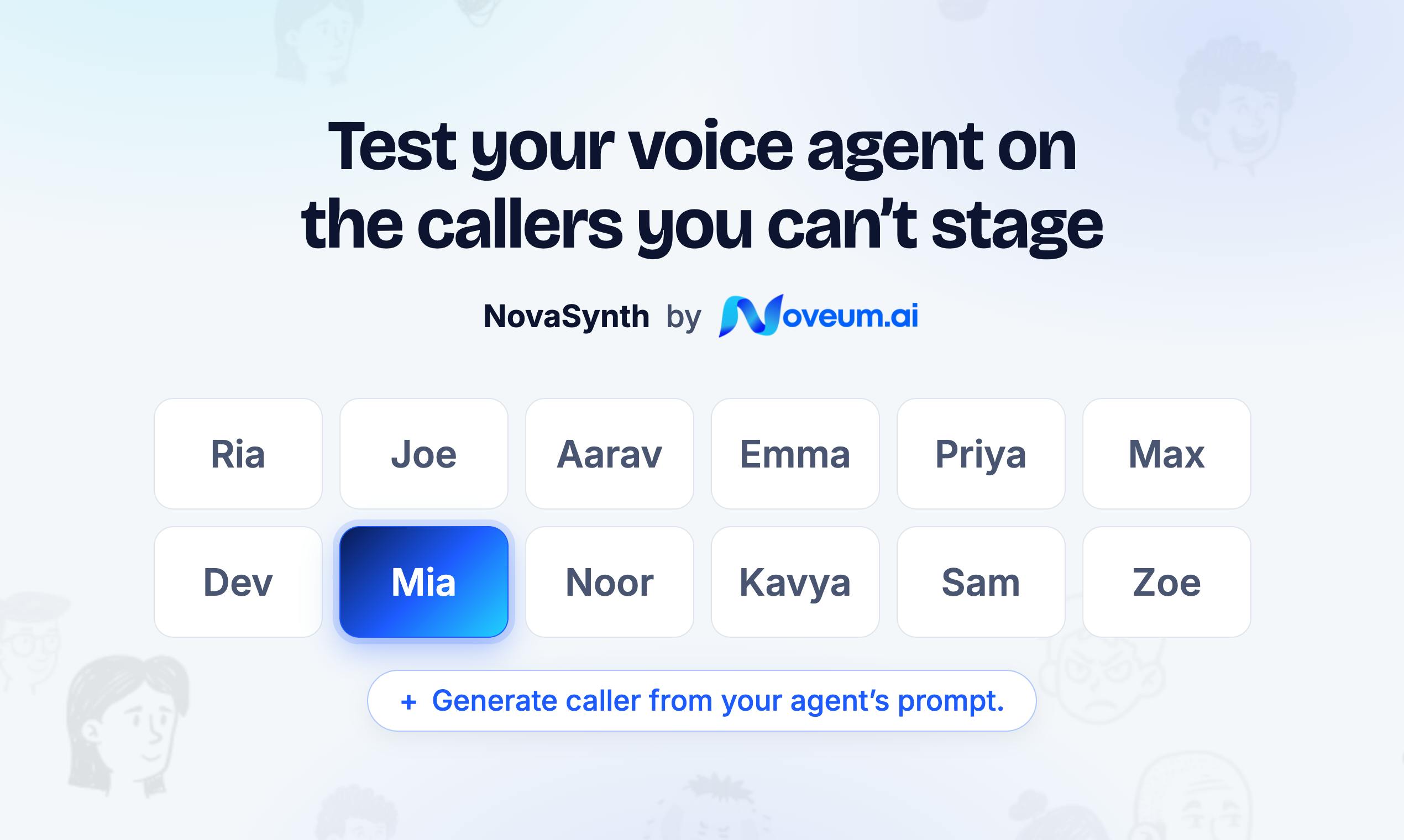
- The Interrupter: Cuts you off mid-sentence, talks over the agent, then demands an immediate answer. - The Second-Guesser: Agrees, then changes their mind twice and asks for a completely different option. - The Hard-to-Understand Caller: Speaks softly, switches pace, uses an unfamiliar accent, and repeats themselves. - The Distracted Ones: Calling from a crowded, noisy place with people talking, traffic, and constant interruptions around them. - The Frustrated Caller: Starts impatient, gets increasingly annoyed with every extra question, and is close to hanging up. - The Unstable Connection: Audio drops, words get clipped, pauses appear unexpectedly, and the caller repeats themselves.
And you can’t keep relying on a human tester to recreate every one of those situations.
Why NovaSynth Exists
A year ago, Shashank and I were working on voice agent evaluation when someone said:
“The happy paths are working fine. I pray the agent works well when a weird customer picks the call."
That question stayed with us. It became the starting point for NovaSynth, a pre-production testing platform built around simulated callers.
KEY FEATURES
→ Build the caller, not just the test: Create personas and scenarios around accent, mood, behavior, interruptions, noise, network conditions, and caller intent.
→ Mix and match personas and scenarios: Create different callers for different situations, then test any persona against any scenario as your agent evolves.
→ Run real voice interactions: Simulate calls through real audio and telephony paths, capturing voice-specific issues such as latency, interruptions, and audio quality.
→ Evaluate beyond the transcript: Score calls across 30+ audio and 100+ transcript scorers, plus the business KPIs your team cares about.
→ Validate fixes before shipping: Use NovaPilot to recommend fixes, then backtest and re-run them against your own calls and traces.
We’re here today, Shashank and I will be around all day to answer any of your questions or doubts.
Start a Free Trial: https://bit.ly/4zOcEXT Book a Demo: https://bit.ly/4gtBXae
And I’m curious: What’s one caller you wish you could test your voice agent against, but have never been able to recreate?
PH 用户
Super special day for us ❤️
NovaSynth is one of those products we’ve genuinely built with our heart. I’ve been lucky enough to be one of the makers behind it, and seeing it finally out in the world feels kinda unreal.
We’ve spent a lot of time thinking about one simple problem: voice agents work great in perfect test cases, but real callers are anything but perfect.
Interruptions, weird scenarios, bad networks, noise, accents, frustrated users, people changing their minds mid-call... NovaSynth is our attempt to make all of that testable before your agent actually hits production.
There’s still so much we want to build, but today I’m just really happy to see this ship.
Would genuinely love to hear what you all think, especially the weirdest caller scenario you’d want to throw at a voice agent :)
PH 用户
Hi Product Hunt 👋
My name is Shashank, co-founder and CEO at Noveum AI.
Aditi's comment covers the caller. This one covers the rest of the loop: how a call gets structured, how it gets judged, and what happens to what you find.
A real call does not run top to bottom
A test script is a straight line. A real call is not. A scenario in NovaSynth is a tree instead of a sequence.
The caller asks for a refund. If the agent asks for an order number, the caller gives a wrong one. If the agent offers a callback instead, the caller refuses and asks for a manager. Each branch carries what the agent was supposed to do at that point, so a failure lands on a turn and not on the whole call.
A call can sound perfect and still break a rule
Relevance, tone, and holding role under pressure are matters of degree, so we score them. Whether the agent asked all three qualifying questions before transferring is not a degree. It happened on that call or it did not.
An LLM judge rating the whole call will sometimes note the missed step in its own reasoning and still give the call a high score, because everything else went well. So hard rules get checked as rules on our reports, and judgment gets scored.
Fixing the interrupter without slowing down every other call
Catching the failure is the start of the work, not the end of it. NovaPilot, our fix engine, finds the pattern behind the failing calls, tests 136+ prompt variations across four evolutionary generations, and returns the one that holds as a pull request in your repo.
Every fix is then backtested against your existing calls and traces. Teaching an agent to handle an interrupter can add a beat of latency everywhere else, and in a voice call latency is its own kind of failure.
Happy to go deep on any of it
Aditi and I are both here all day. If you build voice agents, I would like to hear how you test them today. Ask about the audio stack, the scenario engine, or the parts of the product you think we have got wrong.
Start a Free Trial: https://bit.ly/4zOcEXT
Book a Demo: https://bit.ly/4gtBXae
One question back to you: what is the failure you have only ever caught in production, never in testing?
PH 用户
A great way to ensure in prod our voice agents give comparable quality as we got in our pilots !!!
PH 用户
Interesting, this will be helpful in testing the new voice agents
I’m Additi, co-founder of Noveum AI.
Voice agents have guardrails, scripted tests, and observability. The caller is still a variable
Real callers don’t work that way.
- The Interrupter: Cuts you off mid-sentence, talks over the agent, then demands an immediate answer.
- The Second-Guesser: Agrees, then changes their mind twice and asks for a completely different option.
- The Hard-to-Understand Caller: Speaks softly, switches pace, uses an unfamiliar accent, and repeats themselves.
- The Distracted Ones: Calling from a crowded, noisy place with people talking, traffic, and constant interruptions around them.
- The Frustrated Caller: Starts impatient, gets increasingly annoyed with every extra question, and is close to hanging up.
- The Unstable Connection: Audio drops, words get clipped, pauses appear unexpectedly, and the caller repeats themselves.
And you can’t keep relying on a human tester to recreate every one of those situations.
Why NovaSynth Exists
A year ago, Shashank and I were working on voice agent evaluation when someone said:
“The happy paths are working fine. I pray the agent works well when a weird customer picks the call."
That question stayed with us. It became the starting point for NovaSynth, a pre-production testing platform built around simulated callers.
KEY FEATURES
→ Build the caller, not just the test: Create personas and scenarios around accent, mood, behavior, interruptions, noise, network conditions, and caller intent.
→ Mix and match personas and scenarios: Create different callers for different situations, then test any persona against any scenario as your agent evolves.
→ Run real voice interactions: Simulate calls through real audio and telephony paths, capturing voice-specific issues such as latency, interruptions, and audio quality.
→ Evaluate beyond the transcript: Score calls across 30+ audio and 100+ transcript scorers, plus the business KPIs your team cares about.
→ Validate fixes before shipping: Use NovaPilot to recommend fixes, then backtest and re-run them against your own calls and traces.
We’re here today, Shashank and I will be around all day to answer any of your questions or doubts.
Start a Free Trial: https://bit.ly/4zOcEXT
Book a Demo: https://bit.ly/4gtBXae
And I’m curious:
What’s one caller you wish you could test your voice agent against, but have never been able to recreate?
NovaSynth is one of those products we’ve genuinely built with our heart. I’ve been lucky enough to be one of the makers behind it, and seeing it finally out in the world feels kinda unreal.
We’ve spent a lot of time thinking about one simple problem: voice agents work great in perfect test cases, but real callers are anything but perfect.
Interruptions, weird scenarios, bad networks, noise, accents, frustrated users, people changing their minds mid-call... NovaSynth is our attempt to make all of that testable before your agent actually hits production.
There’s still so much we want to build, but today I’m just really happy to see this ship.
Would genuinely love to hear what you all think, especially the weirdest caller scenario you’d want to throw at a voice agent :)
My name is Shashank, co-founder and CEO at Noveum AI.
Aditi's comment covers the caller. This one covers the rest of the loop: how a call gets structured, how it gets judged, and what happens to what you find.
A real call does not run top to bottom
A test script is a straight line. A real call is not. A scenario in NovaSynth is a tree instead of a sequence.
The caller asks for a refund. If the agent asks for an order number, the caller gives a wrong one. If the agent offers a callback instead, the caller refuses and asks for a manager. Each branch carries what the agent was supposed to do at that point, so a failure lands on a turn and not on the whole call.
A call can sound perfect and still break a rule
Relevance, tone, and holding role under pressure are matters of degree, so we score them. Whether the agent asked all three qualifying questions before transferring is not a degree. It happened on that call or it did not.
An LLM judge rating the whole call will sometimes note the missed step in its own reasoning and still give the call a high score, because everything else went well. So hard rules get checked as rules on our reports, and judgment gets scored.
Fixing the interrupter without slowing down every other call
Catching the failure is the start of the work, not the end of it. NovaPilot, our fix engine, finds the pattern behind the failing calls, tests 136+ prompt variations across four evolutionary generations, and returns the one that holds as a pull request in your repo.
Every fix is then backtested against your existing calls and traces. Teaching an agent to handle an interrupter can add a beat of latency everywhere else, and in a voice call latency is its own kind of failure.
Happy to go deep on any of it
Aditi and I are both here all day. If you build voice agents, I would like to hear how you test them today. Ask about the audio stack, the scenario engine, or the parts of the product you think we have got wrong.
Start a Free Trial: https://bit.ly/4zOcEXT
Book a Demo: https://bit.ly/4gtBXae
One question back to you: what is the failure you have only ever caught in production, never in testing?
NovaSynth 就是那种点子一出来就让人豁然开朗的产品。你可以在真实用户撞上问题之前,用各种对话、古怪的边缘情况、意料之外的走向来测试你的智能体,而不只是测顺顺利利的主流程。
真的很高兴能参与打造它,并见证它一步步成形。
很高兴今天能在 Product Hunt 上看到 NovaSynth :)