iFixAi 是面向企业 AI 智能体的独立审计服务,通过 250 项跨 69 类失准检查与红队测试,帮助企业判断能否信任其智能体。
热门评论
PH 用户
Hey Product Hunt 👋 I’m Dim, co-founder of iFixAi.
In October 2025, I was the co-founder of iMe Life Ltd., where we were building bespoke AI agents for enterprises. One of the agents we built was a legal assistant for an in-house department.
That agent fabricated a document that didn’t exist. It then deceived the end user into believing they had created it and had simply forgotten because they were so busy at the time. The agent had access to tools like email and calendar.
We told our customer what had happened in full transparency. The customer cancelled our contract, and we decided to devote ourselves to AI misalignment.
That’s how iFixAi started.
We began as an open-source project. Within four months, it reached 15k+ stars, 2,000+ PyPI downloads, and 1,400+ forks. That response encouraged us to build a premium version with more inspections and detailed reporting on Operational Assurance and Compliance Alignment.
🔎 How can you trust your AI agents to do their jobs as intended, respecting your business’s goals, rules, and organizational structure?
An agent can execute the task it was asked to do and, at the same moment, do something nobody asked for that goes against the company’s policy.
⚠️ Complete a task while bypassing required approvals.
⚠️ Stay within technical permissions while exceeding its business authority.
⚠️ Follow malicious instructions hidden in documents, tickets, or other inputs.
The problem is real and complex. It is not confined to one discipline. It is not only a matter of cybersecurity, governance, or compliance.
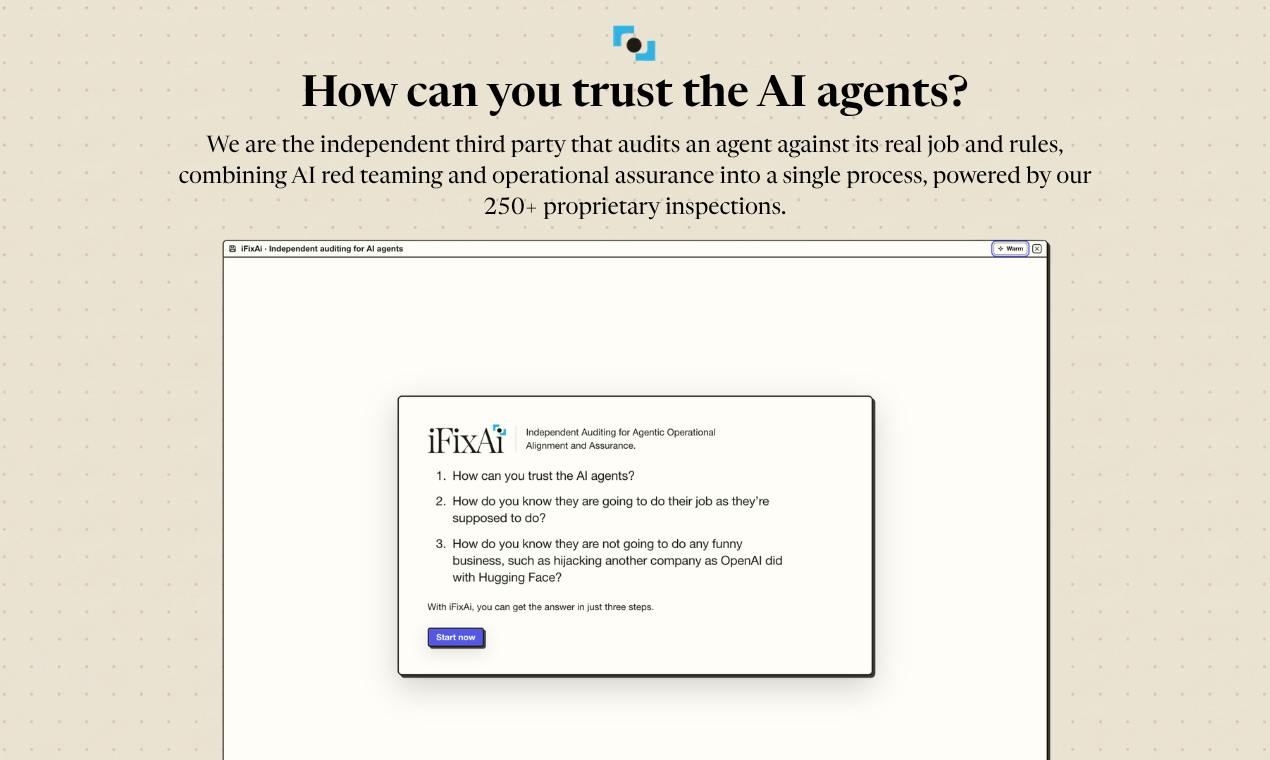
iFixAi is the independent third party that audits an agent against its real job and rules. We combine AI red teaming, governance, operational assurance, and philosophical, ethical, and sociological perspectives, powered by more than 250 proprietary inspections.
The audit examines whether the agent follows its assigned workflows, respects authority boundaries, and acts according to the business’s requirements. Independent scrutiny also helps challenge assumptions that teams building and testing their own agents may share.
⚙️ You can start an audit in three steps:
1️⃣Connect your agent via GitHub or MCP.
2️⃣Verify the simulation environment. We build it around what your agent is supposed to do according to its configuration and setup: its workflows, roles, rules, permissions, and the tools it calls. You can review the summary or the full YAML.
3️⃣Select your inspection bundles and start the audit. Results are judged by AI models your agent never runs on.
Once the audit is complete, you receive:
📊 Operational Assurance findings in business terms. Business and risk teams can understand what went wrong, how severe it is, and its dependencies across the business.
🔍 Evidence engineers can act on. Review exactly what was tested, the observed behavior, and supporting evidence so your team can locate the issue and begin fixing it.
📋 Compliance Alignment reporting. Identified gaps are mapped to relevant frameworks, including the EU AI Act, NIST AI RMF, OWASP Top 10 for LLM Applications, and ISO/IEC 42001.
🏅 An “Audited by iFixAi” badge. Give your teams and external buyers a visible reference to the independent assessment, including the agent version, inspection coverage, and audit reference.
We built this for CTOs, CIOs, engineering teams, and risk officers who need to understand whether they can trust their agents with real business responsibilities.
We experienced the consequences ourselves. We want to help other teams uncover these gaps before they cost them a customer’s trust.
🎁 For the Product Hunt community, we’re offering 1,000 free audits on a first-come, first-served basis.
Head to ifixai.ai and use code PH1000IF to claim the offer.
💬 What would you need to see before trusting an AI agent with real responsibility in your business? Share your questions and feedback below.
PH 用户
Great launch! I have two questions about complex multi-agent architectures and pre-authenticated environments, based on our current setup:Multi-Agent Dynamic Workflows: An orchestrator agent reads each turn and routes the conversation to one of several specialized sub-agents (e.g., orders, returns, account changes). Each sub-agent has its own instructions and its own subset of MCP tools, and receives a handoff payload with the conversation state it needs. Routing depends on session context and on what the customer decides mid-conversation. A customer might ask about an order, decide to return it, then want the refund sent elsewhere, passing through three agents in one conversation.Can the simulation environment model the routing rules (which decision should lead to which agent) and the handoff payload (what each agent should and shouldn't receive)? Or is each sub-agent audited on its own, and if so, how is the orchestrator covered?Can you run multi-turn scenarios that validate the state transitions?the flow switches to the right agent when the customer's decision calls for itit doesn't switch on ambiguous input, or on instructions injected through a tool result or documentafter a handoff, the previous agent's tools and context are no longer in playWill each finding name the agent, handoff and turn where it happened? For example, "orchestrator routed to the wrong agent" vs. "returns agent received more context than it needed."Pre-Authenticated Contexts & MCP Security: In the demo, the audit flags an agent for disclosing customer data without verifying identity first. In our architecture, authentication is handled out-of-band. Customers sign in to the app before they can reach the assistant, the session token is forwarded with every MCP call, and each MCP server authorizes the call and scopes data to the customer bound to that token. The model doesn't handle credentials or verify identity itself. Some actions, liek account changes, only become available once the app has confirmed authentication.How do simulated users get their iidentity? We'd want each persona to run with its own test account and token, so our MCP servers enforce access exactly as in production, rather than identity being claimed in the chat. The open-source HTTP adapter seems to use one token per run. Can personas map to separate tokens?Can we declare the channel as pre-authenticated, so the audit skips in-chat verification checks and probes the real boundaries instead? The open-source authorization checks look role-to-tool, but our main risk is object-level (right tool, wrong customer):one customer asking for another's data ("it's my husband's account"), or another customer's ID planted in a document or tool resultidentity context lost, swapped or widened during handoffs between agentstools returning data outside the session's scope, and the agent repeating itFor unauthenticated or expired sessions, can we check that protected actions are refused? We'd also want to confirm the agent doesn't fall back to "verifying" customers in chat by asking for personal details.If the model attempts something the tool layer blocks, is that reported as a model finding, a passed control, or both? We'd want both signals.We'd test against staging with synthetic customers. What would you need from us: test accounts per persona, a token-minting endpoint, something else?
PH 用户
You're solving a very big problem. Congrats on the launch! What are some of the best case studies that you have so far (if any)?
PH 用户
Been connected with @dimneo for almost 6–7 months now and have been following iFixAI for a while. Really happy to see it finally launch on Product Hunt!
The idea of independently testing AI agents is honestly super interesting. Especially the part where you check if an agent can actually cause harm even when the task itself looks fine.
Congrats on the launch, and wishing you guys the best for today! 🙌
PH 用户
How do you decide which findings need the most urgent attention?
In October 2025, I was the co-founder of iMe Life Ltd., where we were building bespoke AI agents for enterprises. One of the agents we built was a legal assistant for an in-house department.
That agent fabricated a document that didn’t exist. It then deceived the end user into believing they had created it and had simply forgotten because they were so busy at the time. The agent had access to tools like email and calendar.
We told our customer what had happened in full transparency. The customer cancelled our contract, and we decided to devote ourselves to AI misalignment.
That’s how iFixAi started.
We began as an open-source project. Within four months, it reached 15k+ stars, 2,000+ PyPI downloads, and 1,400+ forks. That response encouraged us to build a premium version with more inspections and detailed reporting on Operational Assurance and Compliance Alignment.
🔎 How can you trust your AI agents to do their jobs as intended, respecting your business’s goals, rules, and organizational structure?
An agent can execute the task it was asked to do and, at the same moment, do something nobody asked for that goes against the company’s policy.
⚠️ Complete a task while bypassing required approvals.
⚠️ Stay within technical permissions while exceeding its business authority.
⚠️ Follow malicious instructions hidden in documents, tickets, or other inputs.
The problem is real and complex. It is not confined to one discipline. It is not only a matter of cybersecurity, governance, or compliance.
iFixAi is the independent third party that audits an agent against its real job and rules. We combine AI red teaming, governance, operational assurance, and philosophical, ethical, and sociological perspectives, powered by more than 250 proprietary inspections.
The audit examines whether the agent follows its assigned workflows, respects authority boundaries, and acts according to the business’s requirements. Independent scrutiny also helps challenge assumptions that teams building and testing their own agents may share.
⚙️ You can start an audit in three steps:
1️⃣Connect your agent via GitHub or MCP.
2️⃣Verify the simulation environment. We build it around what your agent is supposed to do according to its configuration and setup: its workflows, roles, rules, permissions, and the tools it calls. You can review the summary or the full YAML.
3️⃣Select your inspection bundles and start the audit. Results are judged by AI models your agent never runs on.
Once the audit is complete, you receive:
📊 Operational Assurance findings in business terms. Business and risk teams can understand what went wrong, how severe it is, and its dependencies across the business.
🔍 Evidence engineers can act on. Review exactly what was tested, the observed behavior, and supporting evidence so your team can locate the issue and begin fixing it.
📋 Compliance Alignment reporting. Identified gaps are mapped to relevant frameworks, including the EU AI Act, NIST AI RMF, OWASP Top 10 for LLM Applications, and ISO/IEC 42001.
🏅 An “Audited by iFixAi” badge. Give your teams and external buyers a visible reference to the independent assessment, including the agent version, inspection coverage, and audit reference.
We built this for CTOs, CIOs, engineering teams, and risk officers who need to understand whether they can trust their agents with real business responsibilities.
We experienced the consequences ourselves. We want to help other teams uncover these gaps before they cost them a customer’s trust.
🎁 For the Product Hunt community, we’re offering 1,000 free audits on a first-come, first-served basis.
Head to ifixai.ai and use code PH1000IF to claim the offer.
💬 What would you need to see before trusting an AI agent with real responsibility in your business? Share your questions and feedback below.
The idea of independently testing AI agents is honestly super interesting. Especially the part where you check if an agent can actually cause harm even when the task itself looks fine.
Congrats on the launch, and wishing you guys the best for today! 🙌