GLM-5.2 was already used on-prem by @Hugging Face last month to investigate the autonomous-agent intrusion into its infrastructure, after hosted frontier models ran into cyber-safety restrictions.
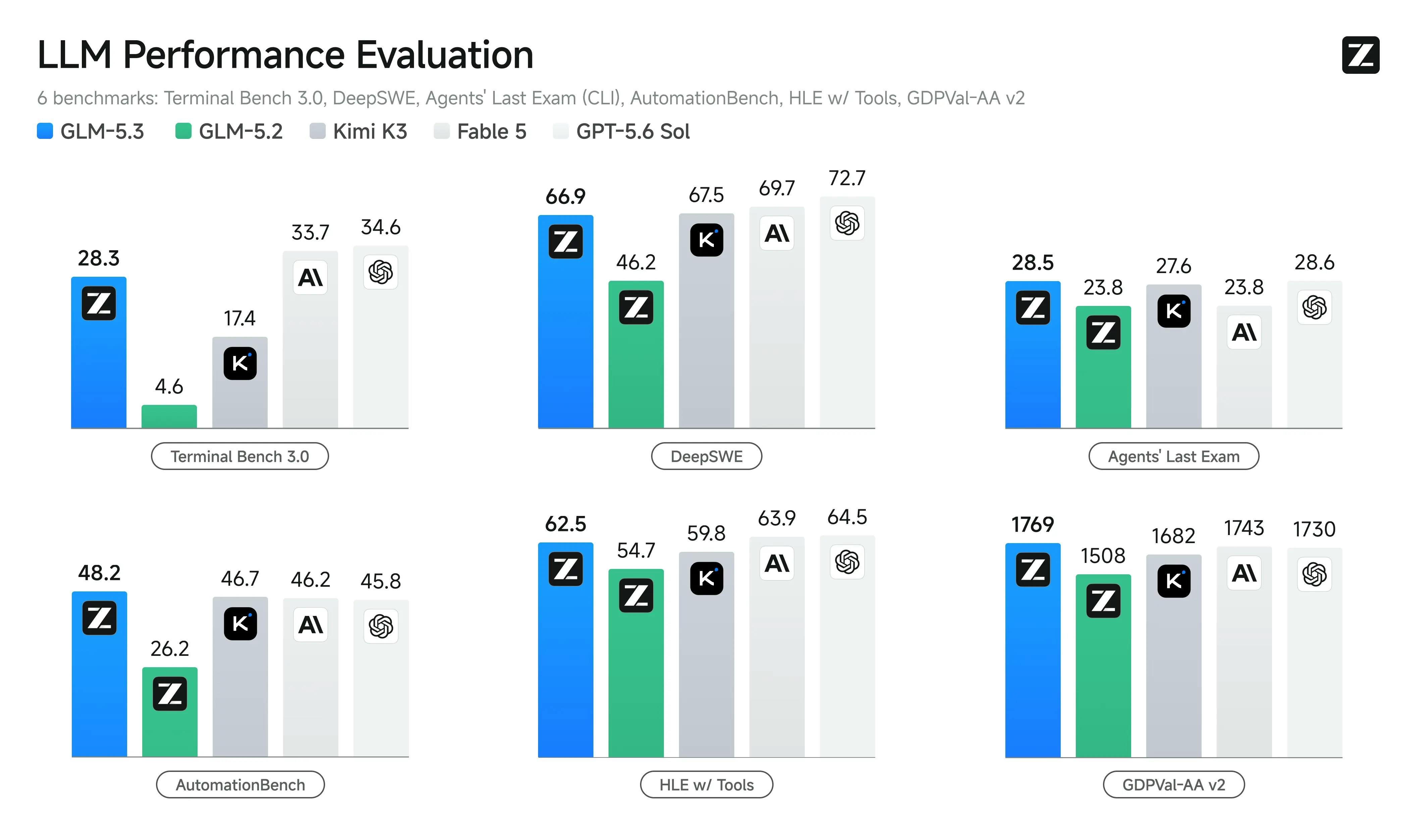
GLM-5.3 keeps the exact same base model as 5.2. @Z.ai simply kept scaling the post-training stack, and the gains are pretty substantial. On their internal code benchmark, 5.3 at high effort beats Opus 4.8 while using less than half the output tokens.
Cyber improved even faster. GLM-5.3 now scores 84.5 on CyberGym, and the model has started reasoning through complete exploitation chains. Their disclosure ledger currently tracks 1,097 critical and high-severity findings across 269 open-source projects.
You can try GLM-5.3 now through GLM Coding Plan and ZCode. Open weights are planned in two weeks, after the remaining safety evaluation and hardening.
PH 用户
I’ve been using GLM-5.3 mainly with TypeScript projects, and I’m quite impressed so far. It performs really well for code reviews, deep research, and day-to-day work in a normal-sized codebase. The coding quality and reasoning are especially strong for an open-weights model.
Where I sometimes run into issues is with larger codebases where the frontend, backend, and database are being developed together. As the project grows and the number of interconnected components increases, it can occasionally lose track of the broader context or make assumptions that don’t quite match the existing architecture.
Overall, though, GLM-5.3 is a very capable coding model. For focused coding tasks and code reviews, it has been excellent in my experience. I’m especially interested to see how it performs as the context and agentic capabilities continue to improve. (my usecase : opencode, hermes-agent with linux terminal)
GLM-5.2 was already used on-prem by @Hugging Face last month to investigate the autonomous-agent intrusion into its infrastructure, after hosted frontier models ran into cyber-safety restrictions.
GLM-5.3 keeps the exact same base model as 5.2. @Z.ai simply kept scaling the post-training stack, and the gains are pretty substantial. On their internal code benchmark, 5.3 at high effort beats Opus 4.8 while using less than half the output tokens.
Cyber improved even faster. GLM-5.3 now scores 84.5 on CyberGym, and the model has started reasoning through complete exploitation chains. Their disclosure ledger currently tracks 1,097 critical and high-severity findings across 269 open-source projects.
You can try GLM-5.3 now through GLM Coding Plan and ZCode. Open weights are planned in two weeks, after the remaining safety evaluation and hardening.
Where I sometimes run into issues is with larger codebases where the frontend, backend, and database are being developed together. As the project grows and the number of interconnected components increases, it can occasionally lose track of the broader context or make assumptions that don’t quite match the existing architecture.
Overall, though, GLM-5.3 is a very capable coding model. For focused coding tasks and code reviews, it has been excellent in my experience. I’m especially interested to see how it performs as the context and agentic capabilities continue to improve. (my usecase : opencode, hermes-agent with linux terminal)