Epho 在云端运行 Claude Code 等 AI 编码智能体,通过 API 即可启动会话并连接仓库,为开发者省去基础设施管理。
热门评论
PH 用户
I am super excited to launch a new agent primitive: Epho - run Claude Code in the cloud. 🚀
Epho is a cloud agent API: it allows you to spin up cloud sandboxes with Claude Code, Codex or OpenCode pre-configured. You can connect your repos, attach files, and use different agents. Send a prompt, get the result.
Epho came out of our own struggles with building our own AI analyst: - Sandboxes give you bare machines; you need to configure them for agentic workloads. - Each agent behaves differently, and you need to build integrations with each of them. - Sandbox providers are not very reliable, which means you need to figure out a multi-provider strategy to avoid failures. - Logging, artifacts, input/output, event streaming, and all of the other operational aspects need to be figured out.
We had to go through the pain ourselves. We got to a point where things got quite reliable, and it became more obvious to us that this should be a primitive on its own: send a POST request, get the events streaming back to you.
Epho is an agents-as-an-API product: you send a request, it spins up a sandbox, configures the chosen harness, clones your repos, and kicks off the agent. It takes care of automatic fallbacks across different providers, handles auth stuff, and just streams back the events and outputs.
Epho uses your own keys, which means you only pay for the infrastructure Epho spins up for you. You send your Anthropic / OpenAI / Opencode API keys, and Epho uses them. We don't charge you per token; we just charge the infrastructure per second.
Epho aims to bring cloud agents into your products easily.
Epho is publicly available today. You get $10 free if you sign up and verify your email, and you can run many hours of compute with that. You can use Opencode's free models to get started even without an API key and just play with it for free.
PH 用户
The repo context part is what stands out. An agent that can start with the right context is much more useful than a blank workspace.
PH 用户
For my code to run, the environment needs to have software installed (For example,. NET). How do you handle this?
PH 用户
yeah Burak! Doing it directly from the repo is a great deal. I'm sure many builders will love it and wish you all the best here!
PH 用户
The question I would want answered first is what happens to a long session when your platform ships.
We run browser agents in serverless containers, and the thing that took us longest to see was that our own deploy cadence was the biggest single source of failures. A run took about 35 minutes. Any merge to main rolled the fleet, and we were merging roughly every 23 minutes. So a real share of runs were being evicted mid-flight by us, not failing on their own merits. The logs just showed the work stopping.
So, two things I would ask of any cloud agent runtime: does a rollout drain in-flight sessions or kill them, and when a sandbox dies does the caller get a distinct signal for evicted versus the agent finishing badly? Those look identical from the outside and they need completely different responses.
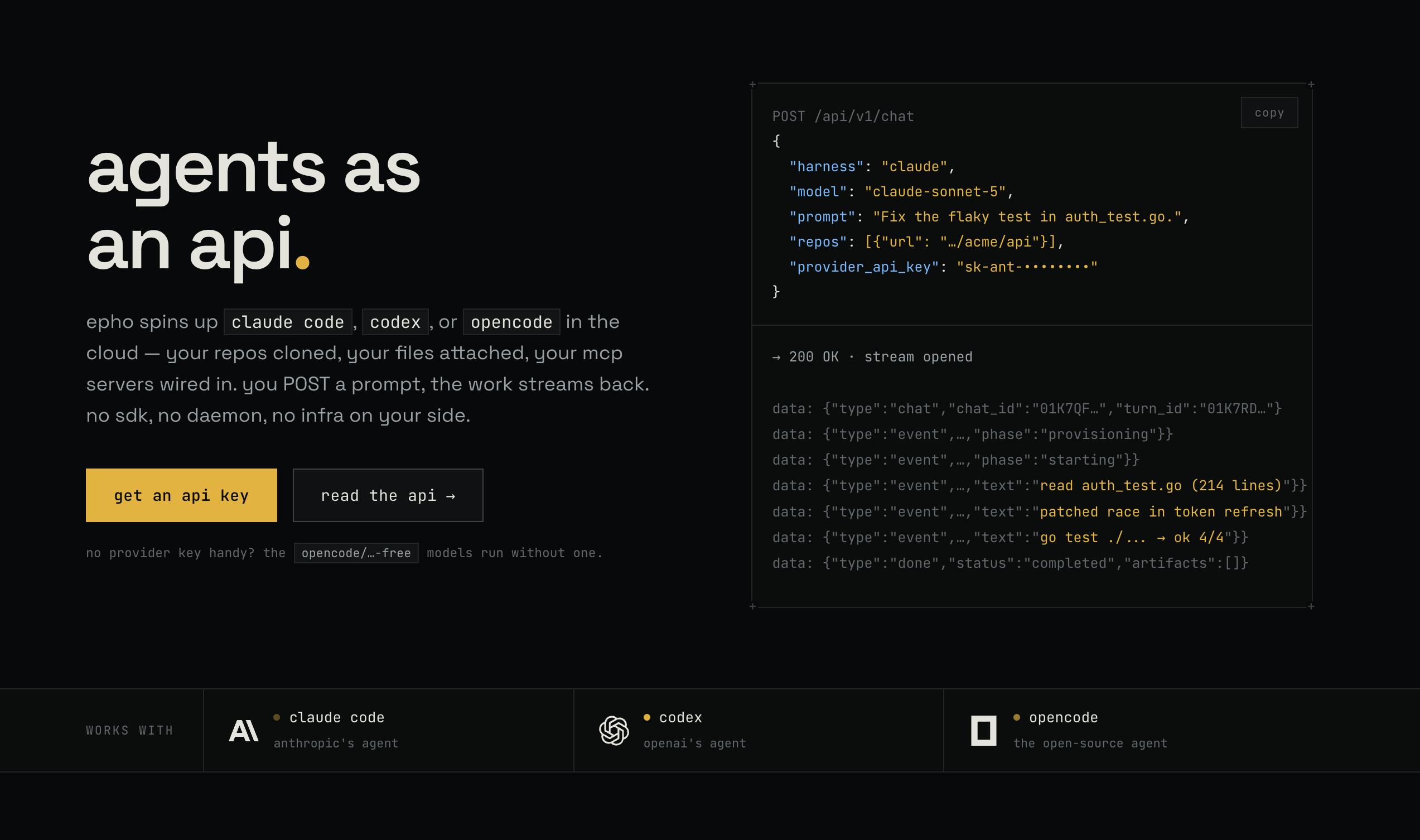
Epho is a cloud agent API: it allows you to spin up cloud sandboxes with Claude Code, Codex or OpenCode pre-configured. You can connect your repos, attach files, and use different agents. Send a prompt, get the result.
Epho came out of our own struggles with building our own AI analyst:
- Sandboxes give you bare machines; you need to configure them for agentic workloads.
- Each agent behaves differently, and you need to build integrations with each of them.
- Sandbox providers are not very reliable, which means you need to figure out a multi-provider strategy to avoid failures.
- Logging, artifacts, input/output, event streaming, and all of the other operational aspects need to be figured out.
We had to go through the pain ourselves. We got to a point where things got quite reliable, and it became more obvious to us that this should be a primitive on its own: send a POST request, get the events streaming back to you.
Epho is an agents-as-an-API product: you send a request, it spins up a sandbox, configures the chosen harness, clones your repos, and kicks off the agent. It takes care of automatic fallbacks across different providers, handles auth stuff, and just streams back the events and outputs.
Epho uses your own keys, which means you only pay for the infrastructure Epho spins up for you. You send your Anthropic / OpenAI / Opencode API keys, and Epho uses them. We don't charge you per token; we just charge the infrastructure per second.
Epho aims to bring cloud agents into your products easily.
Epho is publicly available today. You get $10 free if you sign up and verify your email, and you can run many hours of compute with that. You can use Opencode's free models to get started even without an API key and just play with it for free.
We run browser agents in serverless containers, and the thing that took us longest to see was that our own deploy cadence was the biggest single source of failures. A run took about 35 minutes. Any merge to main rolled the fleet, and we were merging roughly every 23 minutes. So a real share of runs were being evicted mid-flight by us, not failing on their own merits. The logs just showed the work stopping.
So, two things I would ask of any cloud agent runtime: does a rollout drain in-flight sessions or kill them, and when a sandbox dies does the caller get a distinct signal for evicted versus the agent finishing badly? Those look identical from the outside and they need completely different responses.