Atlaso started as a question I couldn't shake: what would it actually take to give AI a real memory?
Not a bigger context window. Not a notes file stapled onto the side. A real memory foundation layer — one that persists, stays honest, and actually helps across sessions and tools.
That question turned into research. We ran our own memory benchmarks, and our approach held up better than the other memory systems we tested against. A lot of the work was in the unglamorous parts: what should be saved, what should be surfaced, and how to make sure memory orients you instead of quietly making things up.
The reason I cared so much is simple — I was tired of re-explaining myself to every AI I used. I'd tell Claude Code about a project, switch to Cursor, and start over. Then again in Codex. Same context, same decisions, same preferences, over and over.
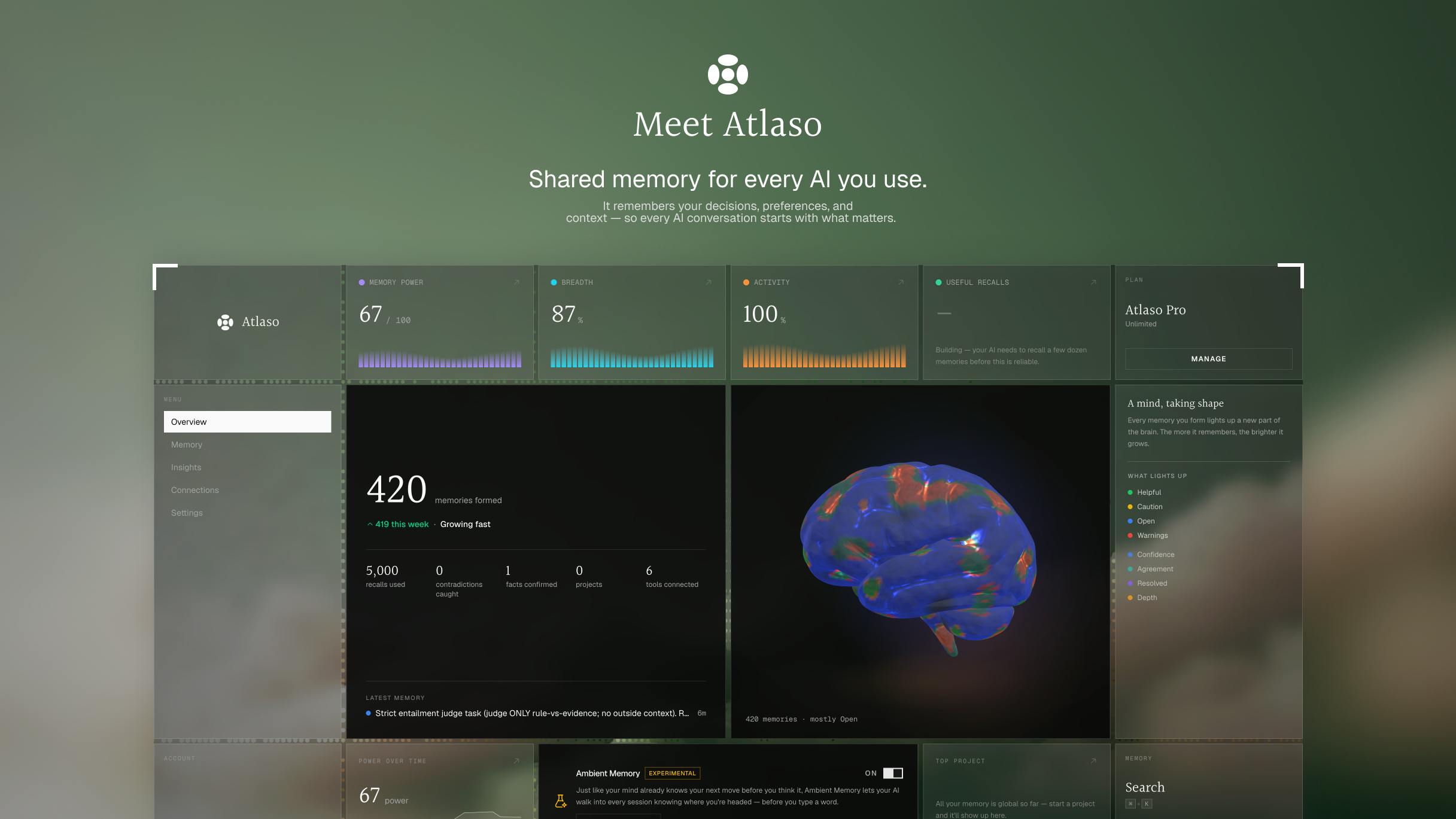
Atlaso is what came out of that work: one memory layer for the AI tools you already use. Connect it once and your context follows you — global memory for what travels with you, per-project memory for what should stay separate.
My favorite part is Ambient Memory — what we call giving AI a subconscious. Before you type a word, Atlaso surfaces a short orientation from your own memory, so the AI picks up where you actually left off. It orients, it never invents.
It's free to start. I'm Ashish, the founder — I'll be in the comments all day, and I'd genuinely love your feedback: what would make AI memory actually useful to you?
PH 用户
"It orients, it never invents" is the claim I'd want stress tested, and not against a benchmark you ran yourself. The hard case for auto capture isn't invention, it's a decision you reversed three sessions ago still getting injected as settled, and it reads exactly as confident as a correct one. So the real question is how a memory dies. If I can't see what got injected and kill it in one keystroke, I'll turn the whole thing off the first time it confidently reminds me of the wrong thing.
PH 用户
Congrats on the launch!
What sets Atlaso apart from Supermemory, which I'm currently using? Especially interested in how you handle developer-focused workflows across tools like Claude Code and Cursor.
Also, is there an easy way to import or sync existing memory from Supermemory, or do we need to start from a clean slate?
PH 用户
Congrats on the launch Ashish, and the way you’re answering people here is genuinely refreshing. Publishing the benchmark you lose on is not a small thing.
My question comes from outside the dev lane. Memory is scoped global and per project, which is right for one person, but at our company half the context worth remembering belongs to the team, not to me. Brand rules, who owns what, decisions we made and why. Today if I correct something, my AI knows it and my colleague’s still gets the old version. Is a shared team memory layer on the roadmap, with the same supersede logic applied across people rather than tools? That’s the version I could roll out to 36 people instead of just using myself.
PH 用户
The global vs project split feels right. Can related repos share one memory space without making it global?
Not a bigger context window. Not a notes file stapled onto the side. A real memory foundation layer — one that persists, stays honest, and actually helps across sessions and tools.
That question turned into research. We ran our own memory benchmarks, and our approach held up better than the other memory systems we tested against. A lot of the work was in the unglamorous parts: what should be saved, what should be surfaced, and how to make sure memory orients you instead of quietly making things up.
The reason I cared so much is simple — I was tired of re-explaining myself to every AI I used. I'd tell Claude Code about a project, switch to Cursor, and start over. Then again in Codex. Same context, same decisions, same preferences, over and over.
Atlaso is what came out of that work: one memory layer for the AI tools you already use. Connect it once and your context follows you — global memory for what travels with you, per-project memory for what should stay separate.
My favorite part is Ambient Memory — what we call giving AI a subconscious. Before you type a word, Atlaso surfaces a short orientation from your own memory, so the AI picks up where you actually left off. It orients, it never invents.
It's free to start. I'm Ashish, the founder — I'll be in the comments all day, and I'd genuinely love your feedback: what would make AI memory actually useful to you?
What sets Atlaso apart from Supermemory, which I'm currently using? Especially interested in how you handle developer-focused workflows across tools like Claude Code and Cursor.
Also, is there an easy way to import or sync existing memory from Supermemory, or do we need to start from a clean slate?
My question comes from outside the dev lane. Memory is scoped global and per project, which is right for one person, but at our company half the context worth remembering belongs to the team, not to me. Brand rules, who owns what, decisions we made and why. Today if I correct something, my AI knows it and my colleague’s still gets the old version. Is a shared team memory layer on the roadmap, with the same supersede logic applied across people rather than tools? That’s the version I could roll out to 36 people instead of just using myself.