I build with coding agents all day, and the bottleneck stopped being the code a while ago. It's the brief. I'd spot something wrong in the UI, then spend five minutes typing what I could have said in ten seconds – and still leave out the screenshot that would have made it obvious.
Aloud is the opposite. Hit record and talk through the build like someone's sitting next to you. Voice, screen and a live transcript, captured together, with the recorder hidden from the video.
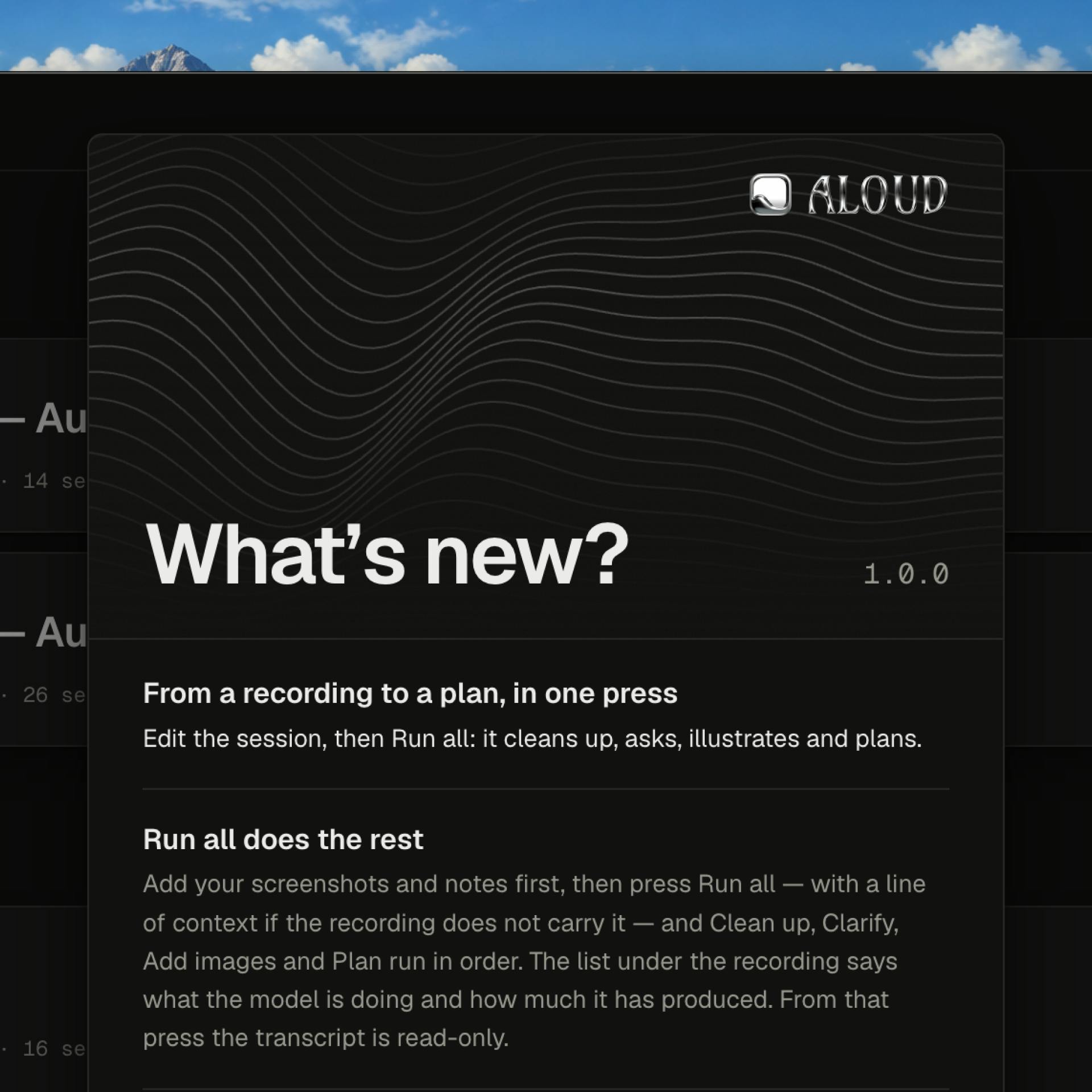
The part I'm proudest of is what happens after you stop. Real speech is a mess: you say "move this over there", you change your mind mid-sentence, you trail off. Aloud rewrites the transcript into what you actually meant, keeps only the calls you stood by, then asks about anything still ambiguous – one question at a time, over the line it's about, with a recommended answer and one alternative. It pulls the frames you were pointing at, crops and captions them, and turns the whole thing into tasks sized for one agent in one worktree. Copy a task, or export the session as a single self-contained HTML file and drop it into Claude Code, Cursor or Codex.
Transcription is on-device Whisper – audio and video never leave your Mac. Only transcript text goes out, and only when you ask for the cleanup.
macOS, Apple silicon, free. What does your feedback → agent handoff look like today? I want to know where this breaks for you.
PH 用户
Very interesting! Is it limited to Whisper, though? I started using Raycast dictation, and it’s pretty reliable.
PH 用户
This is intriguing but I'm confused. I do this process with Whisperflow and tell Claude Code all the things I want to have changed on screens and use Fable to orchestrate Opus agents to make the changes. Since it can see the screen shots on the local dev server for the screen I'm talking about it knows already and I just tell it which button or components to change (not by component library name, just natural language) and it does the updates? Perhaps I'm missing something.
PH 用户
@wojciech_dobry Congrats on the launch. The pointing is the part I'd use. Not having to describe where something is, top left, bottom of this panel, that saves a hell of a lot of time. Definitely worth a try. Thanks for making this.
PH 用户
@wojciech_dobry The brief-quality framing rings true, but spoken feedback leans hard on pointing: "move this up", "that button". When the transcript says "this" and the capture shows where my cursor was, does the task your agent receives carry the actual element or file reference, or just the words?
code a while ago. It's the brief. I'd spot something wrong in the UI, then
spend five minutes typing what I could have said in ten seconds – and still
leave out the screenshot that would have made it obvious.
Aloud is the opposite. Hit record and talk through the build like someone's
sitting next to you. Voice, screen and a live transcript, captured together,
with the recorder hidden from the video.
The part I'm proudest of is what happens after you stop. Real speech is a
mess: you say "move this over there", you change your mind mid-sentence, you
trail off. Aloud rewrites the transcript into what you actually meant, keeps
only the calls you stood by, then asks about anything still ambiguous – one
question at a time, over the line it's about, with a recommended answer and
one alternative. It pulls the frames you were pointing at, crops and captions
them, and turns the whole thing into tasks sized for one agent in one
worktree. Copy a task, or export the session as a single self-contained HTML
file and drop it into Claude Code, Cursor or Codex.
Transcription is on-device Whisper – audio and video never leave your Mac.
Only transcript text goes out, and only when you ask for the cleanup.
macOS, Apple silicon, free. What does your feedback → agent handoff look like
today? I want to know where this breaks for you.