agent-manager is the fastest way I have found to work with coding agents, and everything in it is one keypress.
space on a group starts an agent in the right directory from a single sentence. space on a session answers one that is blocked, without attaching. ctrl+r opens what it changed as whole files, where a comment on a line goes back to that agent as a review prompt. f forks a conversation into a named sibling, T pins a plain shell next to the agents, and yesterday's release added the arrow keys for stepping in and out of a pane.
It runs on tmux rather than replacing it. Sessions are ordinary tmux sessions on their own socket, so quitting the manager leaves every agent running and your own tmux config untouched. Claude Code, Codex, OpenCode, Gemini CLI, Grok and Pi come with status rules, and any other CLI runs as a session right away.
Honest about the scope: cost tracking is not there, and the wheel scrolls but everything else is keys. Go, Apache-2.0, one binary, no daemon.
Happy to hear what breaks for you.
PH 用户
Looks cool! I’m gonna give it a try! For some reason, though, the website link doesn’t seem to work.
PH 用户
One thing I did not expect: review mode became the reason I keep it open, more than the list did.
It started as a way to see which agent was blocked. Then I kept attaching just to read diffs, so ctrl+r grew into whole-file diffs where a comment on a line goes back to the agent as one review prompt. Yesterday's release added stepping in and out of a pane with the arrow keys, which sounds trivial and is now the thing I press most.
If you run more than one agent: where does your time actually go, watching them or reviewing what they wrote?
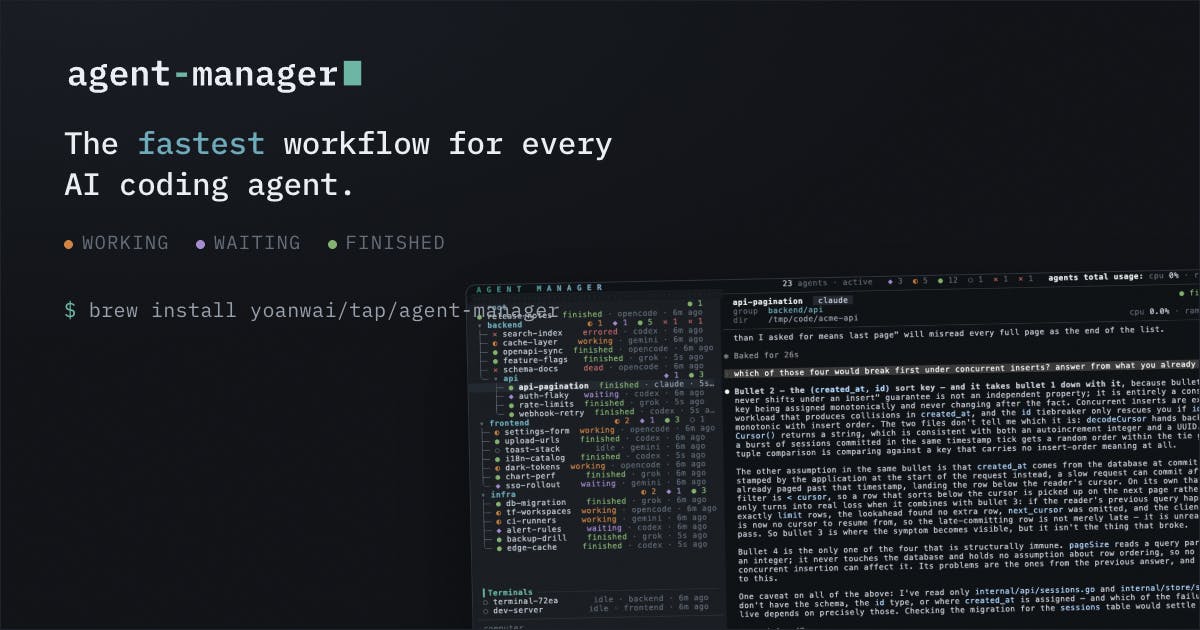
space on a group starts an agent in the right directory from a single sentence. space on a session answers one that is blocked, without attaching. ctrl+r opens what it changed as whole files, where a comment on a line goes back to that agent as a review prompt. f forks a conversation into a named sibling, T pins a plain shell next to the agents, and yesterday's release added the arrow keys for stepping in and out of a pane.
It runs on tmux rather than replacing it. Sessions are ordinary tmux sessions on their own socket, so quitting the manager leaves every agent running and your own tmux config untouched. Claude Code, Codex, OpenCode, Gemini CLI, Grok and Pi come with status rules, and any other CLI runs as a session right away.
Honest about the scope: cost tracking is not there, and the wheel scrolls but everything else is keys. Go, Apache-2.0, one binary, no daemon.
Happy to hear what breaks for you.
It started as a way to see which agent was blocked. Then I kept attaching just to read diffs, so ctrl+r grew into whole-file diffs where a comment on a line goes back to the agent as one review prompt. Yesterday's release added stepping in and out of a pane with the arrow keys, which sounds trivial and is now the thing I press most.
If you run more than one agent: where does your time actually go, watching them or reviewing what they wrote?